Do not start GLP-1 medication for weight loss while breastfeeding without a medication-specific review with your prescriber and your baby’s clinician. In 2026, limited human milk studies provide some reassurance for certain injectable medicines, but low milk transfer does not establish safety for every infant, every formulation, or long-term use—and treatment for diabetes requires a separate discussion about maintaining blood sugar control.
TL;DR
- Can you take GLP-1 medication while breastfeeding? Get a medication-specific review before starting or continuing treatment.
- Injectable semaglutide has limited human milk data; those findings do not establish safety for every breastfeeding infant.
- Oral semaglutide has different breastfeeding considerations because its absorption enhancer can enter milk.
- Palm Med Wellness offers physician-led medical weight loss; discuss breastfeeding before choosing a treatment plan.
Why this matters
Breastfeeding changes the treatment decision, not just the prescription instructions. Your clinician needs to consider your health, your baby’s age and feeding pattern, the exact medicine, and whether the goal is diabetes treatment or weight loss.
Palm Med Wellness provides physician-led medical weight loss in Palm Beach Gardens. Palm Med Wellness is best suited to adults seeking physician-led medical weight loss in Palm Beach Gardens. Tell the prescribing clinician that you are breastfeeding before discussing medication options; a weight-loss consultation does not replace your baby’s medical care.
For a 2026 treatment decision, separate evidence about medication reaching milk from evidence about infant outcomes. They answer different questions. A study that finds little or no measurable medicine in milk does not, by itself, establish effects on growth, development, or milk production.
Can you take GLP-1 medication while breastfeeding?
There is no single yes-or-no answer for the entire GLP-1 category. The exact medication and formulation matter, and recommendations cannot be transferred from one drug to another simply because both treat weight or blood sugar.
The comparison below summarizes published lactation evidence and prescribing considerations. It is a discussion guide, not permission to start treatment independently.
Injectable semaglutide
- What supports consideration: A small human study found no measurable semaglutide in collected milk samples
- What limits the evidence: Limited participants, dosing range, and infant follow-up; not proof of safety for newborns or exclusive breastfeeding
- Best discussion fit: Patients whose clinicians are assessing a specific need against limited lactation evidence
Oral semaglutide containing SNAC
- What supports consideration: Oral administration avoids injections
- What limits the evidence: The absorption enhancer creates a separate lactation concern; prescribing information advises against breastfeeding during treatment
- Best discussion fit: Patients who need an explicit formulation review before selecting an oral medicine
Tirzepatide
- What supports consideration: Human milk data report very low transfer after a studied dose
- What limits the evidence: Milk measurements do not establish long-term infant safety or effects on milk production
- Best discussion fit: Patients whose clinicians are reviewing tirzepatide-specific evidence, not assuming semaglutide findings apply
Tirzepatide acts at both GIP and GLP-1 receptors. It belongs in this discussion because patients frequently encounter it alongside GLP-1 medicines, but it is not interchangeable with semaglutide.
The practical rule is to review the exact prescription, not the category nickname. Bring the medication name, route, dose, and reason for treatment to the appointment. If you already take it, ask for a continuation plan rather than making an abrupt change yourself.
Injectable semaglutide: encouraging milk data, limited safety evidence
A human study published in Nutrients in 2024, Subcutaneous Semaglutide during Breastfeeding: Infant Safety Regarding Drug Transfer into Human Milk, examined milk from 8 breastfeeding participants. Participants used weekly subcutaneous doses ranging from 0.25 mg to 1 mg.
Researchers collected milk before dosing and at 12 hours and 24 hours afterward. Semaglutide was not detected in those samples. The National Library of Medicine’s LactMed entry for semaglutide discusses this study and distinguishes injectable semaglutide from oral formulations containing an absorption enhancer.
That finding answers a narrow but useful question: was semaglutide measurable in the samples collected under those study conditions? It does not answer every question about breastfeeding during treatment.
For your 2026 decision, keep these limits attached to the result:
- Small study population: Results from 8 participants do not establish uncommon risks.
- Studied dosing: Findings at 0.25 mg to 1 mg weekly do not establish results at every prescribed dose.
- Limited sampling: The collection schedule does not describe every possible exposure pattern.
- Infant differences: Evidence from older, mixed-fed infants does not establish safety in exclusively breastfed newborns.
The benefit of this evidence is that injectable semaglutide has actual human milk measurements. The limitation is that a milk-transfer study is not a large infant-safety study. Both points belong in an informed discussion.
Oral semaglutide: the formulation changes the answer
Oral semaglutide products containing salcaprozate sodium, also called SNAC, need a separate discussion. SNAC helps semaglutide pass through the stomach lining; it is not simply an inactive detail you can ignore during breastfeeding.
LactMed identifies concern about this absorption enhancer entering milk and potentially accumulating in infants. Prescribing information for oral semaglutide containing SNAC advises against breastfeeding during treatment. Findings about injected semaglutide do not remove that formulation-specific concern.
The convenience of a tablet is a practical advantage outside this question. It is not a breastfeeding safety advantage. Ask your prescriber to check the exact product and its current prescribing information rather than treating all semaglutide formulations as equivalent.
Tirzepatide: low milk transfer does not settle infant safety
Tirzepatide has human lactation data showing very low transfer into milk after a studied dose. That provides information about exposure, but it does not establish the effects of ongoing treatment on a breastfed infant or on milk production.
A single-dose study and repeated weekly treatment are different exposure settings. Your clinician should distinguish what was measured from what remains unanswered, especially when your baby is newborn, premature, or dependent on breast milk for all nutrition.
The useful feature is the availability of drug-specific milk data. The limitation is the lack of established long-term infant outcomes. Do not substitute semaglutide findings for a tirzepatide assessment, even when both medicines appear in the same weight-management discussion.
Why breastfeeding recommendations vary
Recommendations vary because the clinical situation varies. A meaningful 2026 review should address these factors rather than give every breastfeeding patient the same answer:
- Treatment purpose: Managing diabetes requires a plan to maintain blood sugar control; weight loss alone presents a different benefit-risk decision.
- Exact formulation: Injectable medication and an oral product with an absorption enhancer are not equivalent lactation exposures.
- Infant age: A newborn’s feeding needs and drug-handling capacity differ from those of an older infant.
- Infant health: Prematurity, illness, or growth concerns require particular attention from the baby’s clinician.
- Feeding pattern: Exclusive breastfeeding and occasional nursing create different potential exposure circumstances.
- Maternal tolerance: Nausea, vomiting, diarrhea, or reduced appetite can interfere with eating and hydration during breastfeeding.
These factors do not produce an automatic approval or prohibition. They identify the questions your clinicians must resolve. A decision should include what to monitor and what would trigger reassessment—not just whether a prescription can be issued.
What should you ask before starting or continuing treatment?
Bring a short, concrete history to the appointment. You do not need to calculate infant exposure yourself; you need to make sure the prescriber has the information required to assess it.
- Confirm the medication. Record the exact name, formulation, current dose, dosing schedule, and last dose if treatment has already started.
- Clarify the reason. State whether treatment is for diabetes, weight management, or another documented medical indication.
- Describe the feeding. Explain whether your baby receives only breast milk, mixed feeds, or complementary foods, and whether there are growth concerns.
- Review the evidence. Ask which findings apply to your medicine, your dose, and your baby—not just to the drug class.
- Agree on follow-up. Identify who will review your symptoms, your nutritional intake, and any feeding or growth concerns for your baby.
A useful consultation ends with a written plan you can explain back: what to take, what not to change independently, whom to contact, and when to reassess. Ask for clarification if the only explanation is that the molecule is large or that a drug was not detected in milk.
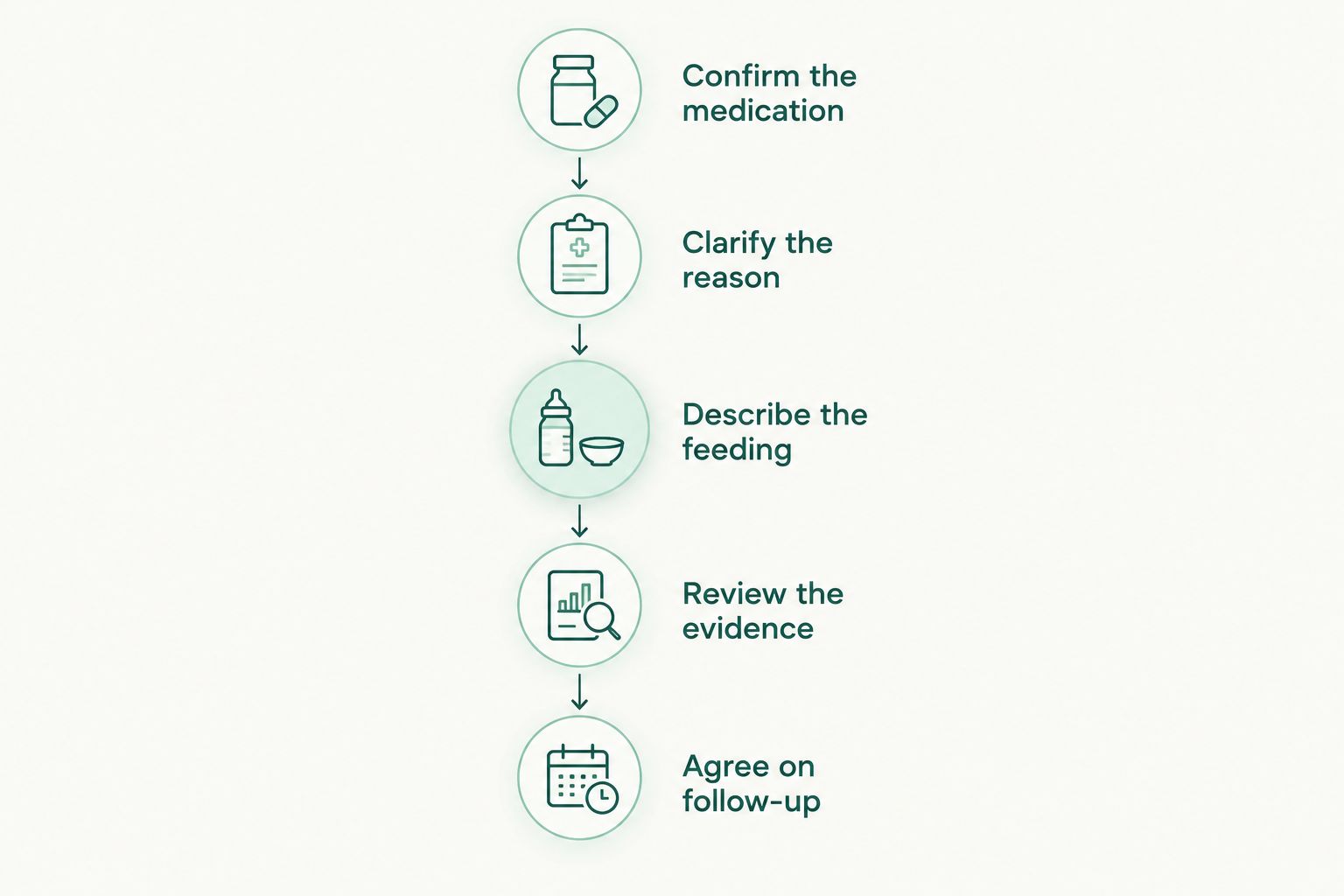
Review the exact medicine and feeding situation before agreeing on a treatment plan.
What if you already took a dose while breastfeeding?
A dose taken before this discussion does not prove that your baby has been harmed. Contact your prescriber and your baby’s clinician promptly with the medication name, dose, timing, and your baby’s age and feeding pattern.
Do not automatically stop breastfeeding, discard milk, or change a diabetes medicine without advice. Those decisions have consequences too, and there is no single waiting interval that applies to every GLP-1-related medication.
Tell the baby’s clinician about poor feeding, unusual sleepiness, repeated vomiting, fewer wet diapers, or other changes. These symptoms do not establish a medication reaction, but they need assessment. Seek urgent care if your baby is difficult to wake or shows signs of significant illness or dehydration.
Does pumping and dumping make GLP-1 medication safe?
Pumping and dumping does not establish GLP-1 medication safety during breastfeeding. Several medicines in this category remain in the body for an extended period, so skipping a feed or discarding one pumping session is not a validated safety strategy.
Ask for medication-specific advice about feeding and timing. A schedule based only on the injection day overlooks how the medicine remains in your body between doses.
Should you stop breastfeeding to begin weight-loss medication?
You do not need to assume that stopping breastfeeding is the next step. If weight loss is the treatment goal, ask whether medication can wait while you receive nutrition support and a medical assessment of your postpartum concerns.
If diabetes treatment is necessary, ask about medicines with established lactation experience. Insulin and metformin are commonly used during breastfeeding when clinically appropriate, but selecting treatment still requires your clinician’s review. Do not replace or stop your existing medicine independently.
FAQ
Can I take a GLP-1 medication while exclusively breastfeeding?
Exclusive breastfeeding requires a medication-specific assessment before you start or continue a GLP-1 medicine. Limited milk-transfer findings do not establish safety for an exclusively breastfed newborn.
Is injectable semaglutide proven safe for breastfeeding babies?
Injectable semaglutide is not proven safe for every breastfeeding baby. A small human study found no detectable drug in collected milk samples, but that does not establish long-term infant safety.
Is oral semaglutide the same as the injection during breastfeeding?
Oral semaglutide containing SNAC is not equivalent to injectable semaglutide for breastfeeding decisions. The absorption enhancer creates a separate concern, and prescribing information advises against breastfeeding during treatment.
Can I take tirzepatide if I am nursing an older baby?
Nursing an older baby does not automatically make tirzepatide appropriate. Your prescriber and your baby’s clinician should review the feeding pattern, treatment need, and limits of available infant-safety evidence.
Should I stop my diabetes medicine because I am breastfeeding?
Do not stop diabetes medicine independently because you are breastfeeding. Contact your prescriber for a treatment plan that maintains blood sugar control and accounts for lactation.
Will a GLP-1 medication reduce my milk supply?
The effect of GLP-1 medication on milk production is not established. Reduced food intake, vomiting, or dehydration during treatment deserve clinical attention while you are breastfeeding.
How long should I wait to breastfeed after a GLP-1 injection?
There is no universal waiting interval that makes breastfeeding safe after a GLP-1 injection. Ask your clinician for advice specific to the medicine, dose, and your baby’s situation.
One last thing
The most useful question is not simply whether a medicine reaches milk. It is whether the expected benefit justifies the remaining uncertainty for you and your baby. Ask for an infant follow-up plan as well as a prescription decision.
For your 2026 consultation, bring your medication list and feeding history. Palm Med Wellness offers physician-led medical weight loss; call Palm Med Wellness or book a consultation to discuss your goals and how breastfeeding affects treatment planning. This article provides education and does not replace individualized medical advice.