Nurses and shift workers’ GLP-1 weight loss is clinician-prescribed treatment that supports appetite regulation and weight management around demanding work schedules. This 2026 guide explains how to assess eligibility, coordinate medication with rotating shifts, and protect nutrition, hydration, and recovery without treating your roster as a personal failure.
TL;DR
- GLP-1 weight loss for nurses and shift workers requires a medication plan that fits shifts, meals, and sleep.
- Palm Med Wellness offers physician-led GLP-1 weight loss care for patients across Palm Beach County.
- Choose treatment by medical eligibility and tolerability, not by a colleague’s prescription or results.
- Track symptoms alongside shift patterns, and ask your prescriber before changing doses or injection timing.
Why GLP-1 weight loss matters for nurses and shift workers
A rotating roster changes when you eat, sleep, and have access to a bathroom or drinking water. Medication decisions must account for those practical constraints, especially when nausea, constipation, vomiting, or diarrhea would interfere with patient care or another safety-sensitive job.
Palm Med Wellness is best for nurses and shift workers seeking physician-led GLP-1 weight loss care in Palm Beach County. The clinic offers medical weight loss programs in Palm Beach Gardens; use the guide to GLP-1 weight loss programs in Palm Beach County to prepare questions about prescribing and follow-up.
Your occupation does not establish medical eligibility. A useful 2026 treatment plan connects your health history with your actual work pattern: consecutive nights, rotating days, overtime, interrupted breaks, and the commute home.
The aim is not to suppress hunger so completely that you stop eating during a shift. It is to pursue medically appropriate weight management while keeping enough nourishment and fluid intake to function safely.
Build a shift-compatible treatment plan
Start with a written schedule and a medical review, not a medication purchase. Use this sequence: Assess eligibility, Map shifts, Plan doses, Protect meals, Track tolerance, Review progress. Each step addresses a different problem; none requires a paid app or a wearable device.
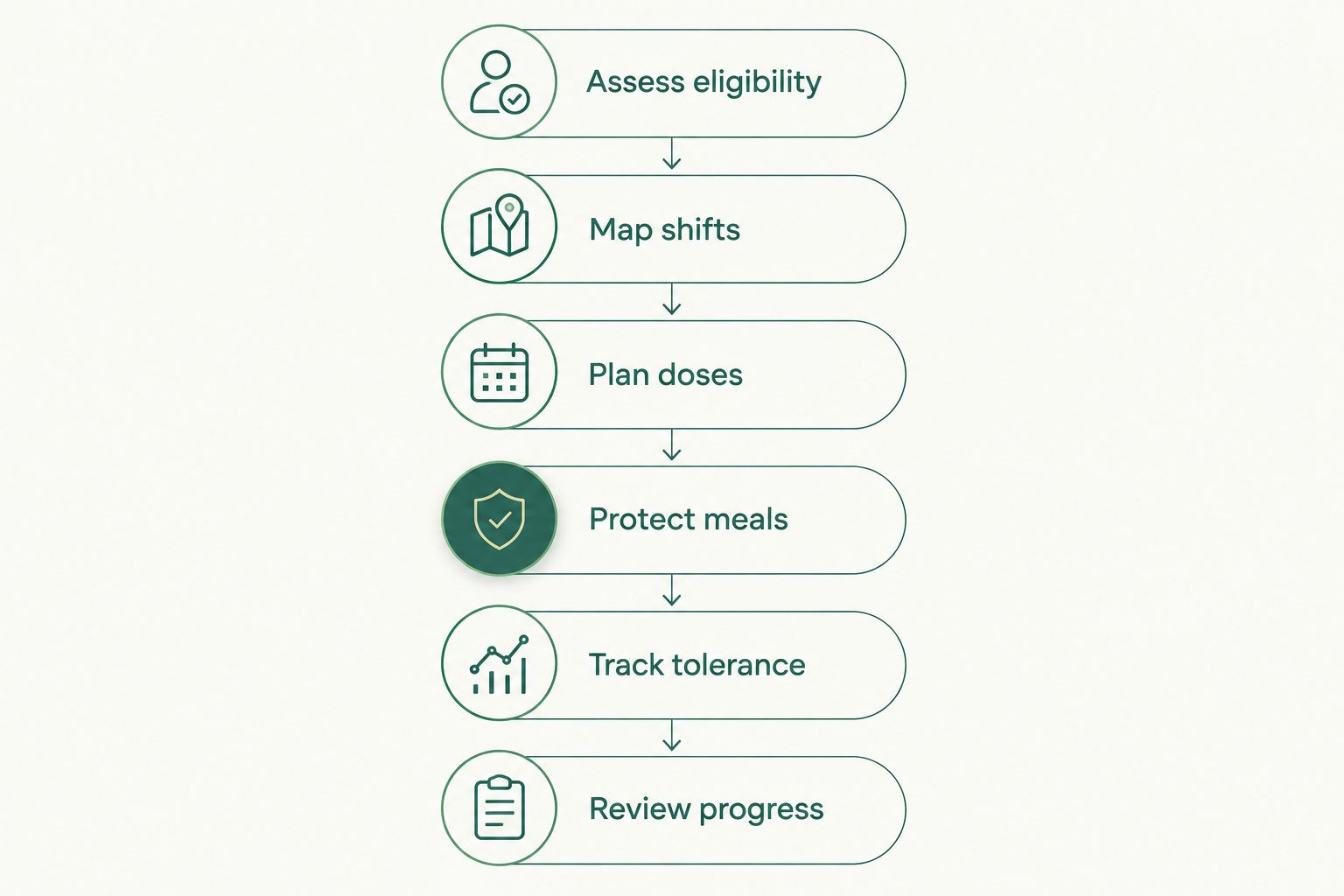
Medical eligibility comes before fitting treatment to your roster.
Assess your medical eligibility
Write down your medication list, relevant diagnoses, prior weight-management treatments, and questions before your appointment. Include supplements and medications taken only occasionally. Being comfortable with clinical terminology does not replace receiving an individual assessment as a patient.
NIH guidance on prescription weight-management medications notes that FDA labeling for several adult chronic weight-management medications uses a BMI of at least 30 kg/m², or at least 27 kg/m² with a weight-related condition. These thresholds are not automatic approval: the prescriber must review the specific medication’s indications, contraindications, and your medical history.
Discuss pregnancy plans, breastfeeding, diabetes treatment, significant gastrointestinal symptoms, and any personal or family history relevant to the medication’s warnings. Your clinician decides which information changes treatment eligibility or monitoring.
- Bring a current medication and supplement list.
- Record previous treatments and why you stopped them.
- Share pregnancy plans and relevant family history.
- Ask which exact medication is being considered.
- Request an explanation of benefits, risks, and alternatives.
Map your shifts before choosing a routine
Use a paper calendar or your phone’s existing calendar to mark work, sleep, meals, and commuting. Include the awkward transitions between nights and days; a schedule based only on your easiest week misses the circumstances most likely to disrupt treatment.
Record what happens rather than what an ideal routine would look like. If a meal break regularly disappears during admissions or handover, your plan needs a backup that works within workplace rules.
Bring that schedule to your prescriber. Palm Med Wellness provides physician-led GLP-1 weight loss programs; discussing your roster during assessment connects the medical decision with the conditions in which you will follow it. Do not assume any clinic offers appointments outside your working hours—ask directly.
- Mark sleep periods as well as work hours.
- Identify shifts with unreliable meal breaks.
- Note access to water, food storage, and bathrooms.
- Flag overtime and day-to-night transitions.
- Choose reminders that remain useful when your roster changes.
Plan medication timing with your prescriber
Start with the prescription label and the pharmacist’s instructions. Put the agreed schedule into a free calendar reminder, and record each dose when you take it. Do not rely on remembering whether an injection happened before or after a run of nights.
For your 2026 treatment plan, ask whether the medication is daily or weekly, what its missed-dose instructions are, and how a schedule change should be handled. These instructions differ between products; advice for one prescription is not interchangeable with another.
Do not change a dose, shorten the interval, or restart treatment after a gap without instructions. Ask how to manage travel and storage, particularly if you work away from home. Follow the exact product’s temperature and handling requirements rather than a colleague’s routine.
- Confirm the medication name and dosing schedule.
- Save the product-specific missed-dose instructions.
- Record doses immediately after taking them.
- Ask what to do after an interruption in treatment.
- Check storage instructions before travel or workplace storage.
Protect meals, fluids, and movement
Begin with ordinary food you can tolerate and carry within workplace rules. Plan an accessible meal plus a practical backup, rather than depending on an uninterrupted cafeteria visit. Appetite reduction is not a reason to replace every meal with coffee.
Include protein-containing foods and a variety of other foods across your waking period. There is no universal protein or fluid target for every shift worker; medical conditions, body size, activity, and treatment tolerance change the advice. A clinician or registered dietitian can set appropriate targets.
CDC adult physical activity guidance recommends at least 150 minutes per week of moderate-intensity activity, alongside muscle-strengthening activity. Treat this as a general health guideline, not a condition for receiving medication. Start from your capacity, and discuss limitations rather than sacrificing needed sleep to meet a target.
- Pack a meal you can tolerate and store safely.
- Keep an allowed backup food available for delayed breaks.
- Include protein-containing foods across your waking period.
- Plan access to drinking water during work.
- Build movement around recovery rather than replacing sleep.
Track tolerance and act on warning symptoms
Use a short note on your phone: dose, shift type, symptoms, food and fluid intake, and anything that affected work. This is more useful than recording weight alone because it helps your clinician assess whether treatment remains tolerable.
Nausea, vomiting, diarrhea, and constipation appear in prescribing information for GLP-1-based weight-management medications. Report symptoms that interfere with eating, drinking, sleep, or safe work. Do not assume that feeling unwell proves the medication is working.
Severe or persistent abdominal pain, repeated vomiting, inability to keep fluids down, or symptoms of dehydration need prompt medical assessment. Trouble breathing or swelling of the face or throat requires emergency care. If you use insulin or a sulfonylurea, discuss low-blood-sugar risk and a response plan with your prescriber.
- Record symptoms alongside doses and shift patterns.
- Report reduced ability to eat or drink.
- Ask which symptoms require urgent assessment.
- Keep your care team’s contact instructions accessible.
- Follow your prescribed low-blood-sugar plan when applicable.
Review progress without chasing faster dosing
Bring your notes and roster to follow-up. Review appetite, symptoms, nutrition, relevant health measures, and your ability to manage ordinary work—not just the latest scale reading. Your plan should remain workable during difficult shifts, not merely during time off.
A 2026 review should also address treatment interruptions, changing health needs, and what happens if progress stalls. Do not respond to a plateau by skipping meals or accelerating dose increases. Ask your clinician to assess the situation before changing treatment.
Weight measurements taken after different sleep periods or shifts are harder to compare consistently. Agree on a repeatable approach that does not encourage compulsive checking. Decisions about escalation, continuation, switching, or stopping belong with the prescriber.
- Bring symptom notes and your updated roster.
- Review tolerability before discussing dose changes.
- Agree on a consistent weight-monitoring routine.
- Discuss interruptions before restarting medication.
- Ask what would trigger a change in treatment.
Compare your weight-management options
The right option depends on eligibility, preferences, health history, and the support you need. Medication is one treatment route, not a reward for having tried harder. This comparison separates the purpose of each approach from the practical limitations a shift worker needs to consider.
Self-directed meal, sleep, and activity planning
- Best for: Building a practical foundation around changing shifts
- Main benefit: Starts with routines and tools you already have
- Key limitation: Does not provide prescribing or individualized medical assessment
Clinician-guided care without medication
- Best for: Assessing health needs and developing an individualized plan
- Main benefit: Adds medical evaluation and referral where appropriate
- Key limitation: Does not include medication-based appetite treatment
Physician-led GLP-1 treatment, including Palm Med Wellness
- Best for: Eligible adults seeking medically supervised medication treatment
- Main benefit: Adds prescription treatment to a broader weight-management plan
- Key limitation: Requires suitability assessment, monitoring, and attention to adverse effects
Endobariatric assessment
- Best for: Exploring whether a procedure is medically appropriate
- Main benefit: Provides evaluation of a procedural treatment route
- Key limitation: Involves procedure-specific eligibility, risks, preparation, and recovery planning
Self-directed planning remains useful alongside medical treatment, but it cannot establish whether a prescription is safe for you. Conversely, starting medication does not remove the need for meals, hydration, or adequate recovery.
Palm Med Wellness also offers endobariatric procedures. That does not make a procedure the automatic next step after a plateau; a clinician must assess the reason for stalled progress and the suitability of alternatives.
Common mistakes nurses and shift workers make
- Copying a colleague’s dose or injection day. A coworker’s prescription reflects their medical history and product instructions. Use your own prescribed schedule, even when you share the same roster.
- Treating appetite suppression as permission to miss meals. An interrupted break and reduced hunger can combine into inadequate intake. Plan food access instead of waiting for strong hunger to remind you.
- Using days off as the only measure of tolerability. Symptoms that seem manageable at home can disrupt a clinical shift. Describe their effect on work when you report them.
- Changing treatment during a roster transition without asking. Moving from nights to days does not automatically require a medication change. Confirm any proposed timing adjustment with your prescriber or pharmacist.
- Hiding treatment gaps or significant symptoms. Your care team needs an accurate account to advise safely. Report missed doses, interruptions, and difficulties eating or drinking without framing them as failure.
FAQ
Can nurses who work nights take GLP-1 medication for weight loss?
Night work alone does not determine eligibility for GLP-1 weight loss medication. A prescriber must assess your health history, the specific medication, and how treatment fits your meals, sleep, and work demands.
What is the best injection day for rotating shift workers?
There is no universal best injection day for rotating shift workers. Agree on a schedule that follows your medication’s instructions, and ask your prescriber before changing it.
Should I skip a dose before a demanding nursing shift?
Do not skip or reschedule a dose solely because of a demanding shift without medical advice. Ask your prescriber how to handle symptoms and schedule changes using the exact medication’s instructions.
Can I start GLP-1 treatment if my BMI is below 30?
Some adult weight-management medications include eligibility at a BMI of at least 27 kg/m² when a weight-related condition is present. Your clinician must check the specific product’s indication and assess whether treatment is appropriate.
What should I eat during a night shift while taking GLP-1 medication?
Plan tolerable meals that include protein-containing foods and fit your workplace’s storage and break rules. Ask your clinician or dietitian for individualized nutrition advice if reduced appetite or symptoms interfere with adequate intake.
What symptoms mean I should get medical help?
Severe or persistent abdominal pain, repeated vomiting, inability to keep fluids down, or signs of dehydration need prompt medical assessment. Trouble breathing or swelling of the face or throat requires emergency care.
Does Palm Med Wellness offer GLP-1 weight loss treatment?
Palm Med Wellness offers physician-led GLP-1 medication programs in Palm Beach Gardens for patients across Palm Beach County. Ask about medical eligibility and how follow-up would fit your shift schedule.
One last thing
Bring your actual roster to a 2026 consultation—not a description of the schedule you wish you had. The missed break, overnight commute, and transition back to days are treatment-planning information, not evidence that you lack commitment.
Book a consultation with Palm Med Wellness to discuss medical eligibility and a treatment plan that accounts for your working life.
Discuss your shift-work treatment plan
Ask about GLP-1 eligibility, medication instructions, and follow-up around your work schedule.