GLP-1 weight loss for perimenopausal women means using physician-supervised semaglutide or tirzepatide alongside dose and lifestyle adjustments that account for declining estrogen, insulin resistance, and muscle loss — not the same generic protocol used for a 28-year-old with no hormonal shifts underway. If your weight has shifted toward your midsection even though your habits haven't changed, it can feel as though your body has changed the rules without telling you. That shift deserves a GLP-1 plan that accounts for it, rather than one that leaves you frustrated by a stall or rebound.
TL;DR
- GLP-1 weight loss for perimenopausal women works best when paired with metabolic testing, not prescribed on medication dose alone.
- Muscle loss accelerates during perimenopause, so resistance training is not optional if the goal is fat loss rather than just a lower number on the scale.
- Plateaus around weeks 12-16 are common in this group and usually call for a dose or protocol adjustment, not quitting the medication.
- Physician-led programs that check thyroid, insulin, and estradiol levels before dosing catch conditions that generic telehealth prescribers miss.
Why this matters
You may be eating much as you always have and still notice weight gain in your 40s or early 50s. Estrogen decline during perimenopause shifts fat storage toward the abdomen and reduces insulin sensitivity; this isn't simply a question of trying harder. GLP-1 medications reduce appetite and slow gastric emptying regardless of hormonal status, but the rate of response and the risk of plateau differ in this group because muscle mass is already declining and sleep is often disrupted by hot flashes and night sweats. A GLP-1 weight loss program in Palm Beach County built around metabolic profiling addresses those variables instead of treating every patient with an identical titration schedule.
A 2022 review of body-composition research reports that one study followed 102 women for five years and found a significant rise in visceral fat after menopause. That's evidence for taking a change in waistline seriously, not proof that every perimenopausal woman needs a different GLP-1 dose.
GLP-1 weight loss for perimenopausal women works when the dose, the diagnostics, and the strength training are matched to the hormonal shift — not when the medication is prescribed as a standalone fix.
Get baseline hormone and metabolic testing
Before starting or adjusting any GLP-1 medication, you deserve a clear picture of what's driving the weight gain. Perimenopause can overlap with thyroid conditions and insulin resistance; checking those factors is more useful than asking you to guess what's changed.
- Request a fasting insulin and glucose panel, not just A1C
- Ask for a full thyroid panel (TSH, free T4, free T3)
- Get estradiol and FSH levels checked if periods have become irregular
- Track waist circumference, not just scale weight, at baseline
- Review current medications for anything that promotes weight gain (some antidepressants, beta-blockers)
Match the GLP-1 medication to your metabolic profile
Semaglutide and tirzepatide are both FDA-approved for chronic weight management, but they don't perform identically for every metabolic pattern. A physician who reviews your labs before prescribing can choose the medication and starting dose more precisely than a one-size questionnaire.
- Compare semaglutide and tirzepatide based on your insulin resistance markers, not brand familiarity
- Ask how titration will be adjusted if nausea or appetite suppression is severe
- Confirm the plan includes follow-up labs at 8-12 weeks, not just a refill
- Look for a provider offering weight loss doctors in Palm Beach Gardens who examine patients in person rather than through a form-only telehealth visit
- Ask directly how the protocol changes for perimenopausal patients specifically
For context, the 2021 STEP 1 trial enrolled 1,961 adults with overweight or obesity, without diabetes. After 68 weeks, those assigned semaglutide 2.4 mg plus lifestyle support lost an average of 14.9% of starting body weight, versus 2.4% with placebo plus lifestyle support. That is a study average, not a prediction for women in perimenopause; the trial did not report a perimenopause-specific result.
Add resistance training to protect muscle mass
GLP-1 medications cause weight loss from both fat and lean tissue, and perimenopausal women are already losing muscle mass at a faster rate than younger patients. Strength training is not about earning your food or pushing through exhaustion. It helps protect muscle during weight loss, rather than leaving more of the weight lost to come from lean tissue.
- Aim for 2-3 resistance sessions per week, even if it's bodyweight or resistance bands at home
- Prioritize compound movements (squats, rows, presses) over isolated machine work
- Increase protein intake to roughly 25-30 grams per meal to support muscle retention
- Track strength numbers, not just scale weight, every 4 weeks
A 2021 STEP 1 body-composition analysis followed 140 adults, 76% of them women. In the semaglutide group after 68 weeks, total fat mass fell 19.3% and lean body mass fell 9.7%. The study measured lean tissue, not how much strength training could prevent its loss; it did not report a result specifically for perimenopausal women.
Track sleep and cortisol alongside your weight
Hot flashes and night sweats disrupt sleep for a large share of perimenopausal women, and poor sleep raises cortisol, which works against appetite regulation and fat loss even while on a GLP-1 medication.
- Log sleep hours and wake-ups for two weeks to identify a pattern
- Flag persistent night sweats to your prescriber; they may point to a hormone workup, not just a GLP-1 dose issue
- Cut caffeine after early afternoon if sleep onset is a problem
- Ask whether a low-dose adjustment (rather than a higher dose) fits better when sleep is already compromised
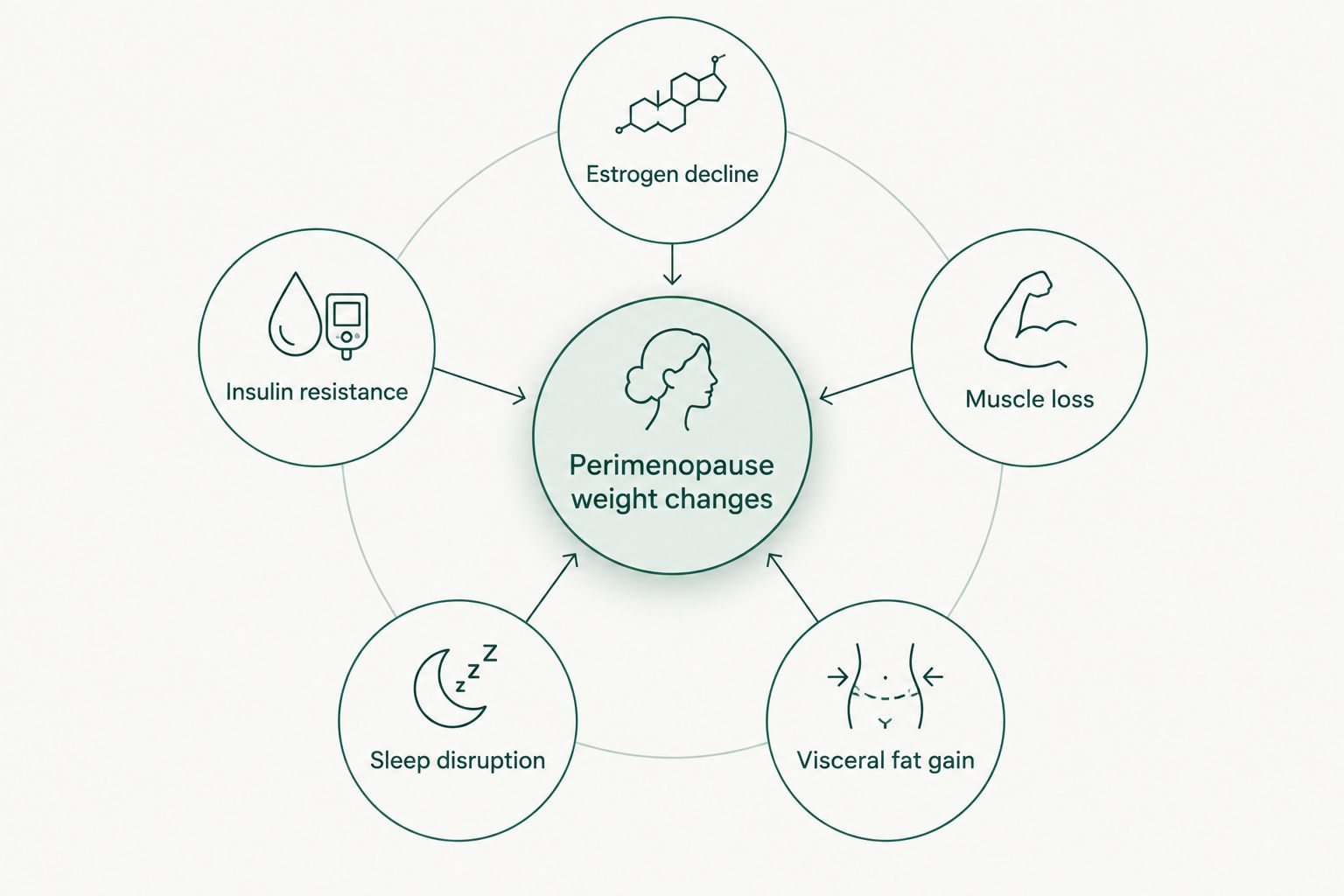
These five factors are why a generic GLP-1 protocol often underperforms during perimenopause.
Adjust the dose at plateaus instead of quitting
A plateau around weeks 12 to 16 can be discouraging, especially when you've already put time and care into the plan. It doesn't mean you've failed. Rather than stopping at the first stall, discuss whether a dose increase, a protocol change, or added strength work makes sense with your prescriber.
- Rule out sodium and water retention from a new supplement or medication before assuming true fat loss has stopped
- Ask your provider about a scheduled dose increase rather than an indefinite hold
- Re-check thyroid and insulin markers if the plateau lasts longer than 6 weeks
- Add one more resistance session per week before making any medication change
Screen for thyroid and hormone conditions before blaming the scale
Weight plateaus in perimenopausal women sometimes trace back to a thyroid shift or new insulin resistance that developed after the initial labs were drawn, not a failure of the medication itself.
- Recheck TSH if fatigue or cold intolerance appears alongside the plateau
- Ask about a fasting insulin recheck if cravings have intensified
- Review whether estradiol has dropped further since baseline testing
Build a maintenance plan before you stop the medication
Stopping a GLP-1 medication without a maintenance plan is one of the most common reasons weight returns within a year, and that risk is higher in perimenopausal women whose baseline metabolism is already shifting downward. A physician-led program builds the tapering and maintenance strategy into the plan from the start rather than leaving it as an afterthought at the final visit. In the 2022 STEP 1 extension, participants who stopped semaglutide and structured lifestyle support regained, on average, about two-thirds of their prior weight loss over the following year. The study was not specific to perimenopause and did not test whether tapering prevents regain. Scheduling a consultation with Palm Med Wellness gives you a chance to map that maintenance phase against your actual labs before you're facing the decision cold.
Get a hormone-aware GLP-1 plan
Physician-led testing and dosing built around perimenopause, not a generic protocol.
Comparison: GLP-1 options for perimenopausal women
Self-pay telehealth GLP-1 (form only, no exam)
- Best for: Women who already have a full hormone workup done elsewhere
- Key limitation: No metabolic testing, no in-person dose adjustment support
Primary care prescribed GLP-1
- Best for: Women with an established PCP relationship
- Key limitation: Limited visit time for perimenopause-specific dose changes
Physician-led medical weight loss program
- Best for: Women whose weight gain tracks with perimenopause symptoms
- Key limitation: Requires in-person or regional access to the clinic
Endobariatric procedure (ESG)
- Best for: Women who've plateaued on GLP-1 or want a non-medication path
- Key limitation: Requires a procedure and recovery period; not first-line for most patients
Verdict: a physician-led GLP-1 program with baseline metabolic testing is the strongest starting point for perimenopausal weight gain — telehealth-only prescribing without labs is the option most likely to stall by 2026's mid-year mark.
Easy-to-miss parts of a GLP-1 plan during perimenopause
- Blaming willpower for a plateau instead of testing insulin resistance and thyroid function first
- Stopping the medication at the first stall rather than adjusting dose or adding resistance training
- Skipping protein and strength work, which trades muscle loss for fat loss instead of protecting lean mass
- Ignoring persistent night sweats as unrelated to weight, when they're driving cortisol and appetite dysregulation
- Choosing a prescriber who never runs labs or sees the patient in person
FAQ
What's the best GLP-1 medication for perimenopausal weight gain?
Semaglutide and tirzepatide are both FDA-approved for weight management, and the better fit depends on insulin resistance and other labs drawn before starting. A physician who reviews metabolic testing before prescribing, rather than defaulting to one medication, gives a more accurate starting point.
Is GLP-1 weight loss for perimenopausal women different from standard use?
The medication mechanism is the same, but perimenopausal women lose muscle mass faster and are more prone to sleep-driven cortisol spikes, so dose pacing and added resistance training matter more in this group. Skipping those adjustments is a common reason plateaus hit earlier.
How much weight can perimenopausal women expect to lose on GLP-1?
Results vary by starting weight, dose, and adherence to strength training, and no responsible clinic quotes a guaranteed number. A physician-led program tracks your progress against your own labs and adjusts the plan rather than promising a fixed outcome.
Does GLP-1 help with menopause belly fat specifically?
GLP-1 medications reduce overall body fat, including visceral abdominal fat that increases as estrogen declines, but they don't target one region exclusively. Resistance training and adequate protein intake support fat loss retention in that area over time.
Can I take GLP-1 medication with hormone replacement therapy?
Many patients use GLP-1 medication alongside hormone replacement therapy, but the combination should be reviewed by a physician managing both treatments, not two separate prescribers working independently. Coordinated labs catch interactions that a single-issue visit would miss.
Why did my GLP-1 stop working during perimenopause?
Plateaus around 12 to 16 weeks are common and are usually tied to a dose that needs adjusting, muscle loss offsetting fat loss, or a new thyroid or insulin shift since baseline labs. Rechecking labs before assuming the medication has failed is the first step.
How much does GLP-1 weight loss for perimenopausal women cost?
Cost varies by medication dose, insurance coverage, and whether the program includes metabolic testing and follow-up visits. Ask a provider directly for current pricing rather than relying on a quoted average, since coverage and dosing change frequently.
Is Palm Med Wellness a good option for perimenopausal GLP-1 treatment?
Palm Med Wellness is a physician-led clinic in Palm Beach Gardens offering GLP-1 programs with metabolic testing built into the plan, which fits patients who want dosing tied to their own labs rather than a generic protocol. Patients outside Palm Beach County will need a local physician-led alternative.
One last thing
It's understandable to focus on which medication to choose. Muscle deserves just as much attention: losing 20 pounds on a GLP-1 without resistance training can mean losing 5-6 pounds of lean tissue. Protecting your strength is part of caring for the life you want to live, not just a number on the scale.