Snowbird and retiree medical weight loss is physician-supervised care aimed at improving weight-related health while protecting strength and maintaining treatment across seasonal moves. For Palm Beach residents who split the year between states, GLP-1 treatment needs a prescribing plan, medication review, and follow-up arrangements that travel with you.
TL;DR
- For weight loss for snowbirds Palm Beach patients need continuity of care before starting GLP-1 medication.
- Palm Med Wellness is best for Palm Beach County patients seeking physician-led medical weight loss.
- Retirees should track strength, nutrition, and medication tolerance alongside weight.
- Arrange prescribing, records transfer, medication storage, and follow-up before every seasonal move.
Why this matters
Your treatment plan should not depend on staying in one state. A seasonal move can separate you from your prescriber, pharmacy, medical records, and usual support. Address those gaps before starting medication or changing treatment.
Palm Med Wellness offers physician-led medical weight loss in Palm Beach Gardens, including GLP-1 medications and endobariatric procedures. For your 2026 care plan, distinguish what a clinic offers locally from what your prescribing team can provide after you leave Florida. Cross-state follow-up requires an explicit agreement, not an assumption.
Why medical weight loss matters for snowbirds and retirees
Snowbirds need continuity between locations. Retirees also need a plan that accounts for existing conditions, other prescriptions, appetite, mobility, and the ability to maintain adequate nutrition. Age alone does not determine whether medication is appropriate.
GLP-1-based treatment can support weight management when prescribed for an appropriate indication. It also requires attention to gastrointestinal side effects and reduced food intake. For an older adult, losing weight without monitoring strength and function leaves an important part of health unmeasured.
The goal is better health and function, not simply a lower scale reading. Ask whether the proposed plan supports walking, climbing stairs, carrying groceries, and participating in activities you value. Those outcomes belong in the discussion alongside weight-related conditions and laboratory results.
How to plan GLP-1 treatment around retirement and seasonal travel
Gather your records before the first appointment
Start with a written medication list and copies of relevant records. Include prescription drugs, supplements, medication allergies, previous weight-management treatments, and the names of your clinicians in both locations. You can organize this yourself without a paid tracking service.
Your clinician needs to know about diabetes treatment, kidney disease, gastrointestinal symptoms, and prior medication reactions. Share relevant surgical history and any personal or family history of medullary thyroid carcinoma or multiple endocrine neoplasia syndrome type 2, because these affect eligibility for certain medications.
Bring the details that allow a safe decision rather than relying on memory during the visit.
- List each medication, its dose, and who prescribes it.
- Bring recent laboratory results and specialist summaries.
- Record previous weight-loss treatments and why you stopped.
- Identify your Florida and out-of-state pharmacies.
- Write down your planned arrival and departure dates.
Confirm eligibility and define a functional goal
Ask your clinician to explain the treatment indication before discussing a specific prescription. For commonly used FDA-approved chronic weight-management medications, adult eligibility generally includes a body mass index of at least 30 kg/m², or at least 27 kg/m² with a weight-related condition. The current prescribing information determines eligibility for each medication.
Those thresholds do not establish that a drug is right for you. Your health history, nutrition, other medications, and treatment preferences still matter. Diabetes treatment and chronic weight management also have different prescribing indications; do not treat every medication in the category as interchangeable.
For 2026, set a goal that includes daily function, not a promised number of pounds.
- Ask which diagnosis supports the proposed treatment.
- Discuss a meaningful mobility or activity goal.
- Review reasons medication might be unsuitable.
- Ask how appetite changes will affect your nutrition.
- Agree on how progress and tolerance will be assessed.
Assign responsibility across both locations
Build a written handoff plan with your existing clinicians first. A shared summary can document the medication, current dose, treatment history, side effects, and next review. Physician-led care can help coordinate the medical decisions, but you still need named responsibilities.
Palm Med Wellness provides medical weight loss in Palm Beach Gardens. Before enrolling, ask how your care would work during time outside Florida; the clinic’s local services do not establish prescribing arrangements in another state.
Telehealth rules depend on where you are physically located during the appointment and the clinician’s authorization to practice there. Confirm those arrangements before departure rather than scheduling a remote visit and assuming it will be permitted.
- Name the clinician responsible for each treatment period.
- Confirm where follow-up appointments can legally occur.
- Identify who handles refills and dose decisions.
- Request a treatment summary before changing locations.
- Agree on where to seek urgent local care.
Protect strength while your appetite changes
Start by recording what you eat and how daily activities feel. A notebook can reveal skipped meals, poor fluid intake, or increasing difficulty with familiar tasks. Your clinician or registered dietitian can then tailor nutrition advice to your appetite, kidney function, and other health needs.
CDC physical activity guidance for adults 65 years and older includes at least 150 minutes per week of moderate-intensity aerobic activity and muscle-strengthening activity on at least 2 days per week, alongside balance activities. Adapt activity to your abilities and medical conditions; these are public-health targets, not an exercise prescription for every patient.
Do not judge treatment success by appetite suppression alone. Difficulty eating enough deserves attention.
- Include protein-containing foods in regular meals.
- Discuss an individualized protein target rather than guessing.
- Choose strength exercises appropriate to your mobility.
- Track changes in walking, balance, and daily tasks.
- Report persistent weakness or difficulty maintaining intake.
Prepare medication and travel logistics
For your 2026 departure checklist, use the instructions supplied with your exact medication. Storage limits, missed-dose directions, and device instructions vary. Do not apply advice for one injection product to another, even when both are described as weight-loss medication.
Ask your pharmacist how to transport the medication safely and what to do after a storage problem. Avoid leaving medication in a hot vehicle or placing it directly against a frozen ice pack. If you cannot confirm whether storage conditions were acceptable, ask the pharmacist before using it.
Plan refills with your prescriber and pharmacy before travel. Do not change injection timing or double a dose to fit an itinerary.
Seasonal moves do not have to mean arranging medication delivery on your own. Palm Med Wellness can help arrange shipment of prescribed GLP-1 medication to an out-of-state address where prescribing and pharmacy requirements permit. Before departure, confirm that your destination state and specific medication are eligible, who will dispense it, and how follow-up will work. Ask whether your prescribed product arrives ready to use without mixing at home, and what preparation, dose measurement, and storage it requires; these details depend on the product supplied.
- Keep the medication label and instructions accessible.
- Confirm storage requirements for the exact product.
- Discuss travel timing before any planned dose change.
- Check the refill process at your destination.
- Ask what to do after a missed dose or temperature excursion.
Review symptoms before changing treatment
Keep a simple record of weight trends, bowel symptoms, appetite, food intake, and activity. Add home blood pressure or glucose readings only when your clinician recommends them. A handwritten log is sufficient if you can share it reliably.
Reduced eating can affect the management of other conditions. Patients taking insulin or certain diabetes medications need a clinician-directed plan to reduce hypoglycemia risk. Never independently stop or adjust another prescription because your weight changes.
Do not increase a dose to force faster weight loss. Severe or persistent abdominal pain, repeated vomiting, inability to keep fluids down, or signs of dehydration require prompt medical assessment; severe symptoms warrant emergency care.
- Follow the prescribed dosing schedule.
- Report side effects before requesting an increase.
- Review other medications as your health changes.
- Bring your symptom and intake record to follow-up.
- Obtain written instructions for urgent and nonurgent concerns.
A practical seasonal-care sequence is to prepare records, establish who prescribes, protect nutrition and strength, plan travel, and review symptoms. Complete the handoff before your location changes, not after a refill problem develops.
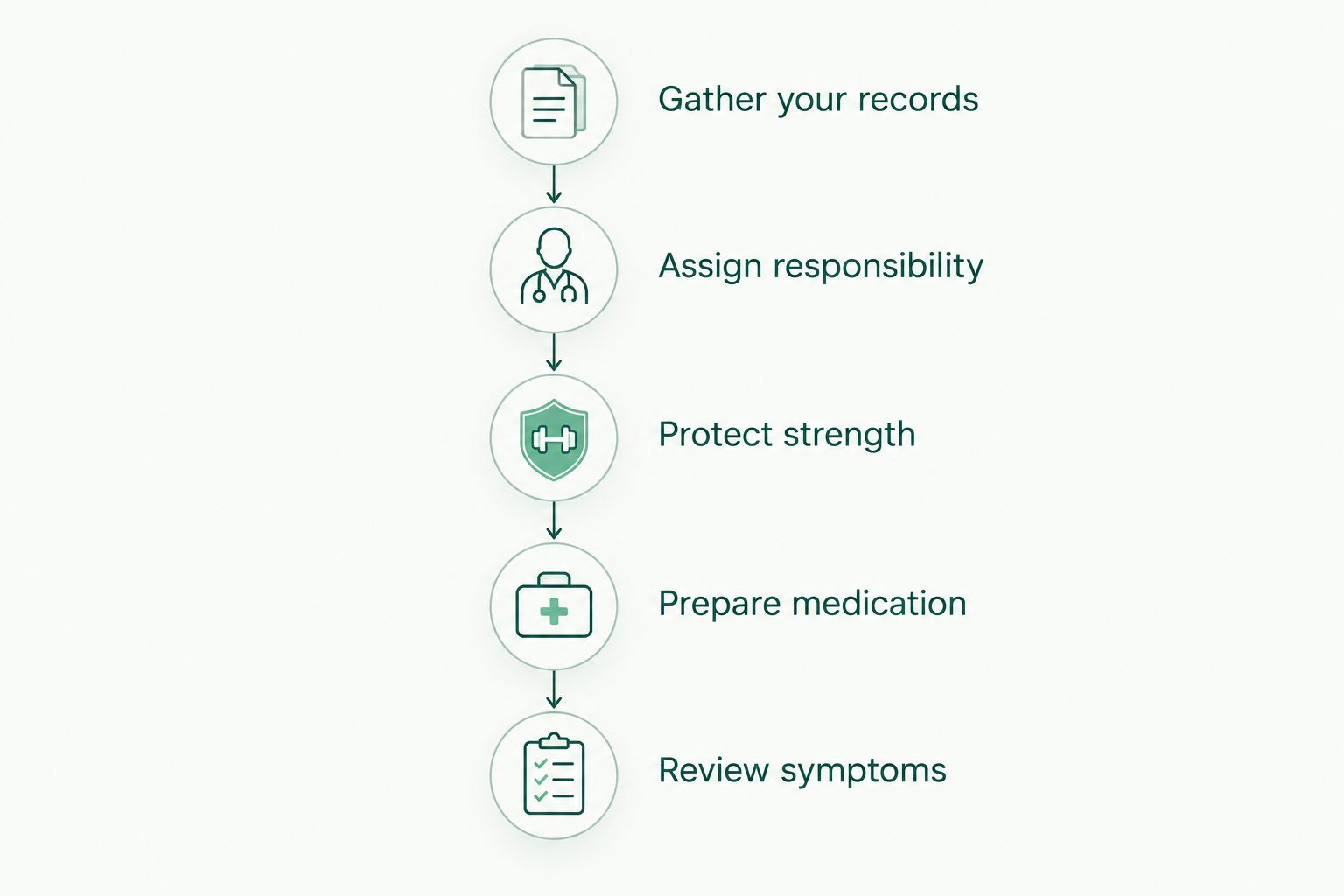
Complete the prescribing handoff before you change locations.
Compare care options for your seasonal schedule
Choose the arrangement that provides accountable prescribing and follow-up in the places you actually live. A convenient appointment format is not enough if nobody owns the handoff.
Palm Med Wellness physician-led medical weight loss
- Best for: Palm Beach County patients seeking local medical oversight
- Main advantage: Local access to medical weight loss, GLP-1 medications, and endobariatric procedures
- Key limitation: Out-of-state follow-up arrangements require confirmation
Coordinated clinicians in both home states
- Best for: Snowbirds with established care in both locations
- Main advantage: Local assessment during each part of the year
- Key limitation: Records and prescribing responsibilities need an explicit handoff
Telehealth weight-management care
- Best for: Patients seeking remote follow-up where permitted
- Main advantage: Appointments do not require travel to a clinic
- Key limitation: Cross-state practice rules and access to physical examination limit suitability
Clinician-guided nutrition and activity care without medication
- Best for: Patients who prefer not to use medication or are not eligible
- Main advantage: Focuses on food intake, strength, and daily function
- Key limitation: Does not include the effects of prescription weight-management treatment
For your 2026 decision, ask every provider the same questions: who prescribes, who handles side effects, and what happens when you leave the state? A clear answer matters more than a particular appointment format.
Common mistakes snowbirds and retirees make
Assuming a Florida prescription guarantees year-round care
A prescription does not establish who will manage treatment after you relocate. Confirm the destination-state plan, refill responsibilities, and access to assessment before your next move. Keep both clinicians informed rather than seeking overlapping prescriptions.
Treating poor intake as proof the medication is working
A smaller appetite is not permission to ignore nutrition. Repeatedly missing meals, feeling weak, or struggling to drink enough requires a treatment review. Ask for help before poor intake becomes your normal routine.
Starting several changes just before departure
A medication change, a new location, and a different pharmacy can make problems harder to resolve. Discuss timing with your prescriber before travel. Do not make a last-minute dose adjustment on your own.
Overlooking procedures and other prescriptions
Tell your procedural team about GLP-1 treatment before anesthesia or sedation. These medications can delay stomach emptying, so the team needs to give individualized instructions. Do not stop treatment based on a blanket internet rule, and do not assume routine diabetes medications need no review.
FAQ
Can I start GLP-1 treatment while spending the winter in Palm Beach?
Yes, if a prescribing clinician confirms that treatment is appropriate and establishes follow-up. Before starting, agree on who will manage medication, symptoms, and refills after you leave Florida.
Am I too old to take a weight-loss medication?
Age alone does not determine eligibility for weight-loss medication. Your clinician should assess health conditions, other prescriptions, nutrition, frailty, and functional goals before recommending treatment.
Can my Florida clinician prescribe after I return to another state?
That depends on the clinician’s authorization to practice where you are physically located and the applicable rules. Confirm the arrangement before departure; a previous in-person visit does not automatically settle cross-state prescribing.
What should I do if GLP-1 medication makes it hard to eat?
Contact your prescribing clinician if reduced appetite prevents adequate eating or drinking. Persistent vomiting, dehydration, severe abdominal pain, or worsening weakness requires prompt medical assessment rather than simply waiting for the next appointment.
How do I travel safely with my weight-loss injection?
Follow the storage and transport instructions for your exact medication and device. Ask your pharmacist about your itinerary, temperature protection, and what to do if the medication freezes or becomes too warm.
Should retirees focus on weight or muscle during treatment?
Retirees should monitor weight alongside strength, nutrition, and daily function. Discuss appropriate resistance exercise and individualized nutrition with your care team, especially if appetite falls or mobility changes.
Do I need to stop GLP-1 medication before a procedure?
Your prescribing and procedural teams should give individualized instructions before anesthesia or sedation. Tell them which medication you use, your dosing schedule, and whether you have gastrointestinal symptoms; do not stop or continue treatment based only on general online advice.
One last thing
Put your current dose and last injection date in the same place as your travel documents. Those details help a receiving clinician distinguish the planned treatment from what you actually took. Include the prescriber’s contact information and any unresolved symptoms in your 2026 handoff summary.
The most useful travel preparation is not a complicated tracking system. It is a readable record and a clinician who knows they are responsible for your next decision.
Related guides
- Choosing weight-loss doctors in Palm Beach Gardens
- Comparing GLP-1 weight-loss programs in Palm Beach County
- Using Apple Health data for GLP-1 progress tracking
- Comparing ESG providers in Florida
Call Palm Med Wellness or book a consultation to discuss physician-led medical weight loss and the questions your seasonal care plan needs to answer.