
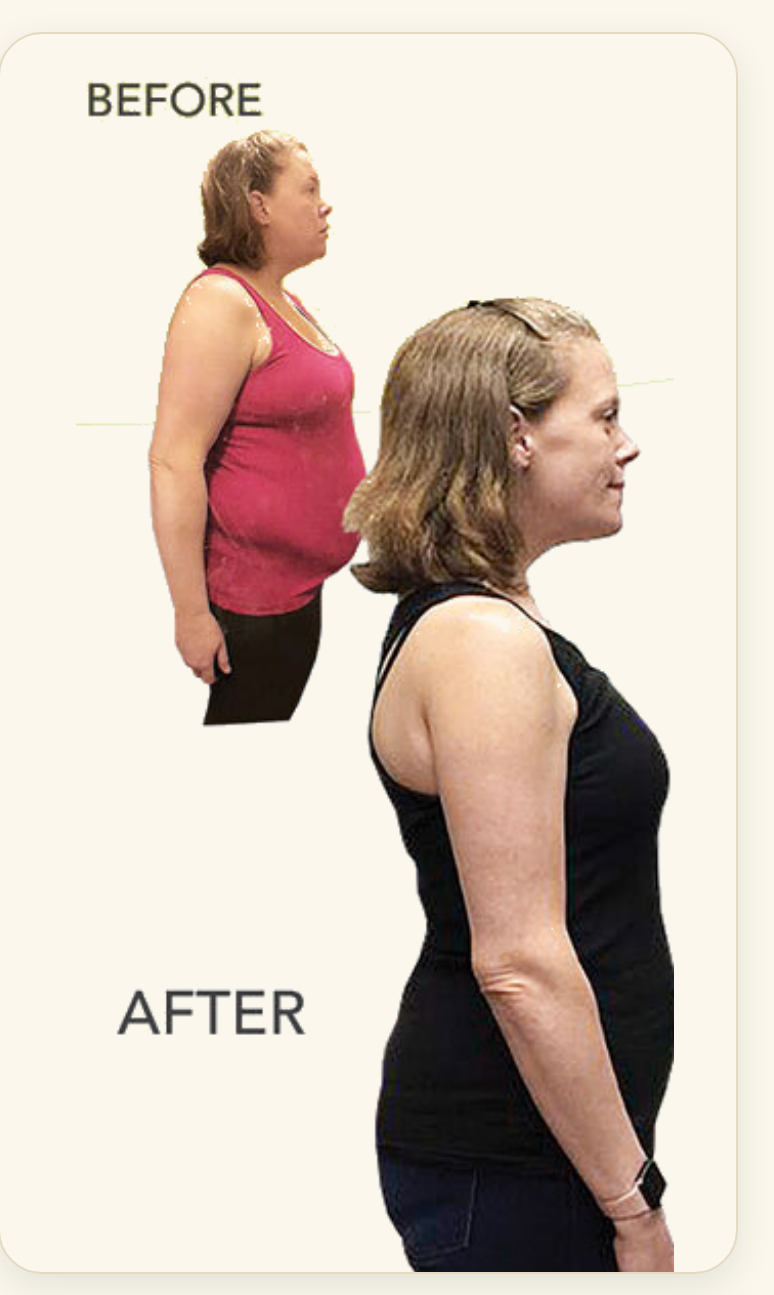
Amy is 41. She has a thyroid condition, which means she had spent years being told — correctly — that her metabolism was working against her, and years being told — less helpfully — that this was simply how it was going to be.
The decision didn't come from a scale or a photograph. Her two-year-old son ran, and she couldn't catch him.
Twenty-four weeks later she was 78.5 pounds lighter and twelve inches smaller at the waist. What she talks about is not the number.
Can you lose weight with hypothyroidism?
Yes. It is often harder, and the reasons are more specific than "a slow metabolism."
An underactive thyroid modestly lowers resting energy expenditure and causes fluid retention. The weight gain directly attributable to it is usually smaller than patients expect — often in the range of five to ten pounds, a meaningful share of which is fluid. That's frustrating to hear when you've gained sixty, but it's important, because it means treating the thyroid alone rarely produces the weight loss patients are hoping for. Correcting the thyroid removes an obstacle. It doesn't do the work.
Get the thyroid properly treated first
Before any medical weight loss plan, thyroid function should be tested and, if treated, optimized. Trying to lose weight while significantly hypothyroid means fighting a headwind that could simply be removed.
A detail that trips people up: levothyroxine absorption is easily disrupted. It's taken on an empty stomach, separated from food, and kept well apart from calcium and iron supplements, which bind it. Patients who start a new nutrition plan sometimes change their supplement timing without realizing they've changed how much thyroid medication they're actually absorbing.
What to ask before starting a GLP-1 with a thyroid condition
GLP-1 medications carry a contraindication related to thyroid cancer. Semaglutide and tirzepatide are not prescribed to patients with a personal or family history of medullary thyroid carcinoma or Multiple Endocrine Neoplasia syndrome type 2 (MEN 2). This is based on findings in rodent studies; whether the risk translates to humans is not established, but the contraindication stands and it is not optional.
An important distinction, because it causes unnecessary alarm: this is not about hypothyroidism, Hashimoto's, or a thyroid nodule. Those are common and are generally not contraindications. It is specifically about medullary thyroid carcinoma and MEN 2. Any physician prescribing a GLP-1 should be asking about this — including your family history — before the first dose. If nobody asks you, ask them.
Weight loss can change your thyroid dose
Levothyroxine dosing is partly weight-based. Substantial weight loss can mean the dose that was right at the start is no longer right at the end. Thyroid function should be rechecked during and after significant weight loss, and the dose adjusted by whoever manages your thyroid care.
This is one of the more common gaps in weight loss care — the weight is managed by one clinician, the thyroid by another, and nobody rechecks the interaction.
Amy's plan was built for Amy. Every programme here is individualised, and a thyroid condition is exactly the kind of detail that changes what the right plan looks like. It starts with a full evaluation by Dr. Mark Amorosino, who is board certified in obesity medicine. Book a consultation to talk through yours.
More patient stories: Keith — 158 pounds and off his CPAP · Steve — 42 pounds and his golf swing back · All success stories

Dr. Mark Amorosino is the Medical Director of Palm Med Wellness and one of the nation’s leading experts in obesity medicine. He has helped thousands of patients achieve lasting weight loss results. His approach blends advanced medical expertise with compassionate, patient-centered care, giving you the confidence that your health is in the best hands. One of a few board-certified obesity medicine physicians in Palm Beach County.