
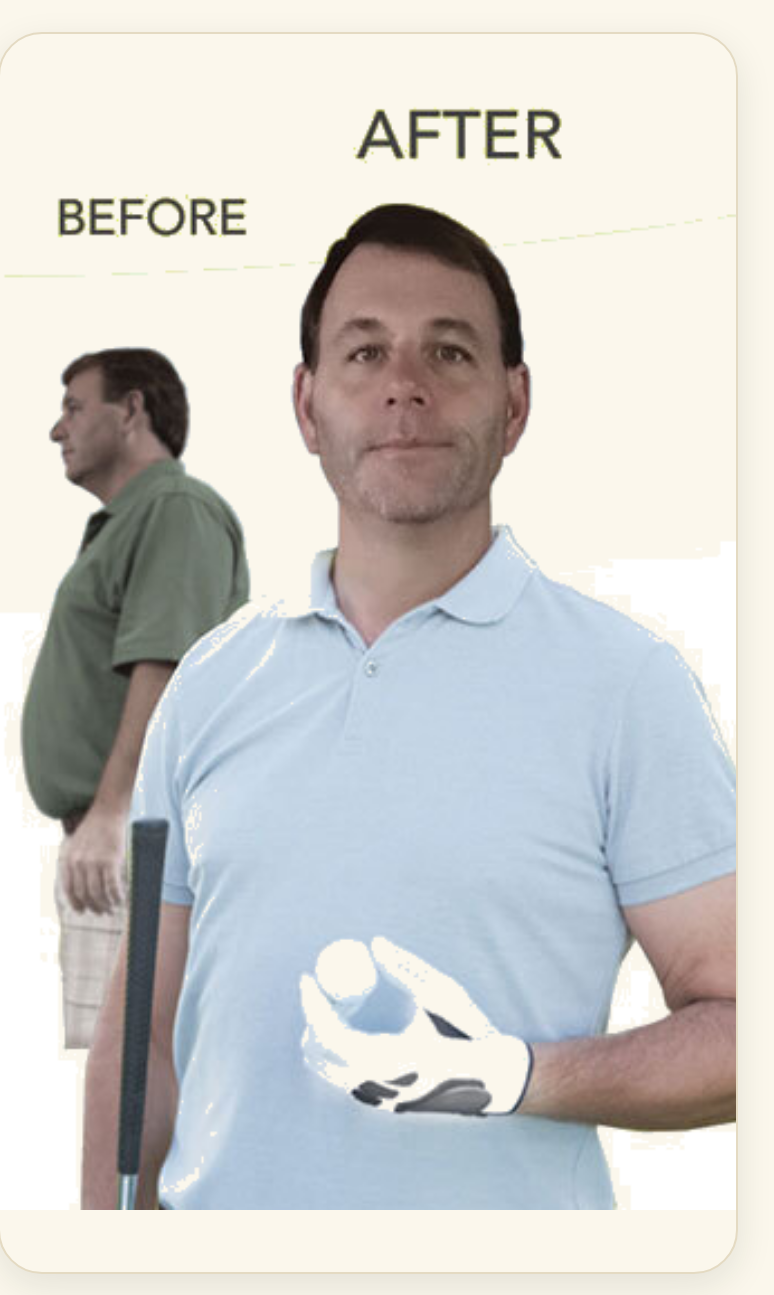
Most men don't call a weight loss clinic because of a number on a scale. They call because something they used to do without thinking has quietly become difficult.
For Steve it was his golf swing. He couldn't get his hips through the way he had in his twenties — a specific, physical, unmistakable limitation that no amount of telling yourself you feel fine can argue with.
Ten weeks later he was 42 pounds lighter, ten inches smaller at the waist, and swinging like he used to.
What's different about losing weight later in life
The mechanics don't change. The margin for error does.
Muscle is the thing to protect. Adults lose muscle mass steadily from roughly the fourth decade onward, and that loss accelerates during weight loss if nothing is done about it. Any weight loss draws on both fat and lean tissue — the goal is to shift that ratio as far toward fat as possible. Losing weight and losing muscle at the same time produces a lighter person who is functionally weaker, which is the opposite of what someone chasing a golf swing wants.
Two things move that ratio: adequate protein, distributed across the day rather than concentrated in one meal; and resistance training rather than cardio. Cardio supports the calorie side. It does not preserve lean mass.
This matters more on GLP-1 medications, not less. GLP-1s work partly by reducing appetite, which makes it easy to under-eat protein without noticing. Patients on these medications should be deliberate about protein and resistance training rather than assuming the medication handles everything — which is one of the reasons a supervised medical weight loss programme tends to produce different results from a prescription alone.
The blood pressure detail worth knowing
Weight loss lowers blood pressure, often meaningfully. For anyone taking antihypertensive medication, that's good news with a practical consequence: the dose that was correct at a higher weight may be too much at a lower one.
Blood pressure should be monitored through weight loss, and medication adjusted by the prescribing clinician as it comes down. Patients occasionally experience lightheadedness during rapid weight loss and assume it's the diet — sometimes it's a blood pressure medication that's now doing too much. Worth raising rather than waiting for it.
Testosterone, briefly
Excess body fat is associated with lower testosterone in men, partly because fat tissue converts testosterone to estrogen. Weight loss often raises testosterone without any direct treatment. This is worth knowing mainly because it works in the direction people assume it doesn't — for many men, addressing weight is the more direct route.
Steve's plan was built for Steve — the meals, the coaching cadence and the medication combined for what he actually needed. Every programme here works that way, and it starts with a full evaluation by Dr. Mark Amorosino, who is board certified in both gastroenterology and obesity medicine. Book a consultation.
More patient stories: Keith — 158 pounds and off his CPAP · Amy — 78.5 pounds with a thyroid condition · All success stories

Dr. Mark Amorosino is the Medical Director of Palm Med Wellness and one of the nation’s leading experts in obesity medicine. He has helped thousands of patients achieve lasting weight loss results. His approach blends advanced medical expertise with compassionate, patient-centered care, giving you the confidence that your health is in the best hands. One of a few board-certified obesity medicine physicians in Palm Beach County.